Monday, 24 February 2014

Whither the Hurry-Up Monster?

Sitting at an airport departure gate last week, waiting for our budget flight to board, I found myself discussing with Mrs Laig the timing of when we should decide to guzzle our scalding tea, wolf down our overpriced sandwiches and take our places in the growing queue.
"There's no rush," I breezily commented. "They haven't deployed the Hurry Up Monster yet."
"The what?" came the cautious reply, knowing that the question might be the opener for another over-large can of explanatory worms. And indeed, it was during my over-long explanation of this particular pop-culture artefact to Mrs Laig that I came to think about its gradual disappearance from the computer game culture that spawned it and then to the manner in which it has gradually migrated further and further into our everyday lives.

So first to the history lesson that Mrs Laig was mostly spared:

The Hurry Up Monster (I won't abbreviate it to HUM) is a device that can be traced back to the days of the (relatively) early platform computer games. In the earliest days of gaming, when one's opponent was almost invariably sitting in the next seat, the impetus to maintain a good pace of play was as complicated as showing a scoreline at the top of the screen and letting competition (and elbows) do the rest. One friend of mine became so adept at competitive multiplayer subterfuge that he was able to unplug an opponent's controller using his toes in the middle of a game, giving rise to an unusual stipulation that only allowed him to play when wearing shoes. 

Hi Scores: The pressure comes from that douche who just knocked you off the #1 spot. Curse you, AAA!
Image: DonkeyKongBlog

As graphics, computer processors and the gaming industry itself began to grow however, single-player platform games began to proliferate widely, offering a frenetic challenge to the lone gamer. One-player games allowed for competition to spill out of the confines of one's living room and into the wider world, with high scores and leaderboards that put gamers into competition with rivals across the world and spawned a profusion of tournaments and sometimes tempestuous rivalries. However, without an elbow-flinging, insult-spewing opponent to pile on the pressure, how to keep the solo gamer challenged and safely in the sweet-spot between comfort and frustration? Whilst PacMan and other such arcade titles were able to take advantage of early "artificial intelligence" to pursue the player around a fixed arena and others, such as Jet-Set Willy and Donkey Kong, placed the focus on careful planning and precisely-judged joystick-nudging, many other titles relied upon our age-old enemy: time. Space Invaders managed to cement itself as one of the most successful games in history by substituting even the most basic AI with the simple mechanic of "moving one row down and getting a bit faster", imbuing that last stupid alien spaceship with the seemingly supernatural skills of a lateral ninja as it zipped across the screen with the fatal and invulnerable inevitability of a shark in a swimming pool full of pigs. 

A Simple Plan
Image: Threadless.com / Design: NGee

As games continued to evolve, players found themselves offered more choice in how to compete or progress, with multiple routes available, more complex enemies to outwit or score-boosting items to collect. How then to maintain the urgency? Some games adopted a ticking timer in which to complete a task or level, whilst others, most notably the Super Mario Bros. franchise, dispensed with the headlong rush or, in the case of Sonic the Hedgehog, continued to encourage it, but prevented undue dawdling throught the use of the "Invisible Wall", which followed the player through the world like the End of History, ensuring the the past (or at least the path so far trodden), once left behind, lay permanently sealed and inaccessible.

Hurry up already! You only have a few seconds until your frog...starves?
Image: Retrogames.com

I have always been a little bit of an explorer. Not so much a bold adventurer into new lands, but a delver into corners and little secret places, both in games and in places I happen to visit. For me, then, the Invisible Wall always felt like something of a cop-out. In blocking the way back it did nothing to demand more urgent play but merely served to frustrate my instinct to investigate the increasingly complex worlds that computer games began to inhabit. Walked past that cave? Want to know what was in it? Sorry pal, history's dead; maybe you can have a look next time you play this game through from the beginning. Now go chase some more coins.

So what was the alternative to a ticking clock or ninja aliens in a game that also allowed for some strategy or freedom of exploration? In my opinion, the device that did the best job of injecting truly primal urgency back into gaming, without the arbitrary nature of the Death Clock or the Invisible Wall was the Hurry Up Monster. My limited trawl of the internet for articles about this illustrious beast has come up inexplicably short. Inexplicably, given that mention of such a creature, albeit with gamers of a certain vintage, seems to bring instant recognition, regardless of what individuals may, or may not, have called it themselves.

It comes for us all.
Image: badsneaker.net/

For me, my earliest brush with this noble enemy was in the single-screen bird-combat-based lunacy of Joust. For the uninitiated, Joust was an arcade (and later console) game in which the player (a lance-toting knight sitting atop an ostrich, blessed with limited powers of button-bashing-granted flight) spawned on a screen populated by similarly-attired, vulture-mounted adversaries, who could, by means of being hit from above (although rarely with the lance), be unseated and transformed into brightly-coloured eggs, which could then be collected in return for points. As the game progressed, these enemies would gradually improve in their tactics and speed, and the levels themselves would gradually become more hostile, as floors were gradually replaced by pits of lava that, in turn, eventually hosted bird-seizing infernal hands. Despite this gradual ramping up of difficulty, the game sought to challenge the player with more than just the prospect of carefully-waged mounted aerial medieval warfare. For behind the scenes a far deadlier foe lurked, awoken by that twisted hybrid of Mario's wall and Frogger's timer: the secret invisible alarm clock.

This sinister device would tick quietly away as the player(s) (for this was a game open to (semi)cooperative play) went about their wing-flapping, egg-collecting business until, with a screen-spanning HURRY UP! message, the Monster would be awoken. Unlike the flapping foes of the main game, this beast, unnamed in the game but known variously by gamers (as yielded from the few internet resources that I could find) as the "Dragon", "Pterodactyl", or just "Skel" would erupt onto the scene with all the supernatural speed of a final-row Space Invader, but also with the targeted malice of a vengeful hunter woken from its slumber with only YOU in mind. The effect of the Hurry Up Monster's heralding and imminent arrival (there was always a panic-window of a few seconds after the announcement) can be likened to players, locked in deuce at a tennis match, being told that "in 30 seconds the wolves will be released". Imagine how much more fun Wimbledon would become.

Panic! When you're there, it's actually very threatening...
Image: MobyGames / Contributed by Servo (55902) / Credit: Williams
Link to video: http://www.youtube.com/watch?v=LO0AlvOlWUw

At this point strategy would go out of the window and reflexes became all. Unlike the passive stolidity of the wall or the hopeless inevitability of the time-limit, the genius of the Hurry Up Monster was that beneath the panic there was the gossamer thread of hope that blazed into a fuse wire with every successfully-evaded pass. Because unlike the sands of the Death Clock, the monster could be cheated. Before each pass across the screen the beast would announce itself with a roar, then fling itself across the screen like a furious missile before leaving from the other side. Although winged death was almost a certainty as pass followed pass, with luck and skill escape was possible. There were even rumours that, if timed just right, it was possible to slay the beast, though I never met anybody able to claim that they'd succeeded.

Joust was not alone in invoking a roaring, unconquerable foe to harry the dawdling adventurer. Platformers such as Rainbow Islands (sequel to Bubble Bobble) and The New Zealand Story also encouraged exploration, strategy and thoroughness but ensured that dallying came with an adrenalin-hungry pricetag. This furious enemy brought to mind the terrible swooping beasts of legend, from Tolkien's Smaug to the great dragon of Beowulf; incalculably powerful weapons of flesh and scale defeated only through the ingenuity and charmed lives of the vulnerable heroes they sought to destroy. Here was urgency not as arbitrary line but as heroism. Not a death-knell but a gong of war. Not an end to history or a wound-down clock but a winged challenge to life. This was the Hurry Up Monster - if you want to keep playing, you'll have to fight or run.

If you can see this, you're too slow
Image: Redbubble.com / Design: VortexDesigns

I'm sorry, where was I?

Ah yes. Airport waiting rooms.

As I trawled the internet with a cursory search for an image or description to match my rambling on the subject of the Hurry Up Monster I found myself confronted by page after page of people expressing their frustrations or worrying about the timings of their important life decisions. As the landscape of computer gaming technology has developed and changed, computer games have diverged into processor-hungry worlds for players to explore at their leisure (the Grand Theft Auto franchise, MMOs such as World of Warcraft or beautiful "explore-em-ups", such as Gone Home, without points, enemies or even, some would suggest, any point at all) or else into throw-away apps that return us to the days of the high score board and the frantic headlong dash (Temple Run and Flappy Bird being prime examples). Whence, then, the Hurry Up Monster? It seems to have fallen between two stools; a relic of the joystick age in an age explored by mouse & keyboard or tackled by taps on a portable screen. 

Or perhaps not. Perhaps the greatest trick the Hurry Up Monster ever pulled was convincing the world he didn't exist.

During my brief hunt for information I tried searching for the specific phrase and found myself looking at the title of an article reading something along the lines of "How I beat the Hurry Up Monster". At first I took this to be some sort of play-through guide to Joust (possibly even detailing a strategy for achieving the fabled dragon-kill), until I read the first line of the summary and found that it was an article by a woman who felt that she had overcome the biological and societal pressures placed upon her to have a baby (ultimately by not having a baby - sorry for the spoiler). But this got me thinking: perhaps that metaphor, whether intended by the author or not, is a rather more apt one than it seems. We often speak about a "biological clock" ticking down as women age, but the whole problem with it is that there is no timer for us to see and race against. An invisible wall? Perhaps. But perhaps what we face is more like a slumbering monster, waiting to be awakened by a call that we won't hear, and this is what makes such decisions such a gamble and such a threat. Not to labour this particular metaphor too much further but the "biological clock" strikes me more as a "Hurry Up Monster" whose coming is inevitable, whose attacks we may evade, through skill and luck, but to whom eventual defeat is inevitable if we don't get on with it.

It comes for some of us. In a way. Maybe?
Image: bigkingken

Where else, then, do these societal and biological monsters lurk?

In a modern society we are surrounded by barriers that limit, guide and cajole us through our lives. Many of the stages of our early lives are defined by invisible walls that push us onwards and close the way behind us: from schooling to the period of general "neural plasticity" that creates polyglots, virtuosos and sports prodigies, and the biological staging posts of peak growth, vitality and general fitness that we pass in one direction, never to access so easily again. Time and entropy are the ultimate in Invisible Walls. In our adult lives we are constantly hemmed and harried by ticking timers that guide our priorities and shape our working days and our leisure: from deadlines to train times, holidays to TV timetables (although thanks to the rise of PVRs and on-demand viewing, this last one is coming back under our control). But it is in the personal decisions that shape our lives as a whole that the Hurry Up Monster lurks.

The Hurry Up Monsters of our real lives begin to appear, grow and proliferate as we reach and journey through adulthood; flexing their invisible wings and checking their alarm clocks from time to time as we more through our different life stages. Unlike the monsters in Joust et al, these monsters can't be seen and are clear to us only when we eventually fall prey to them. The first great beasts rear their heads even before we leave school, with choices that we must make about the subjects we study or where we do so that will determine the course of our higher education and later job prospects. From then on the Career Monster watches us carefully, diving across the screen as we choose qualifications, apply for jobs and pursue promotions in a bid to outwit it, always knowing that a misstep could leave us trapped in the wrong position or, worse, the wrong career, with little chance of escape. When is the time to choose? The point of no return? There is no counting timer or obvious wall, only the fear that dogs each decision, the exhilaration of a temporary escape and almost always the knowledge that the monster will return a year or two down the line to challenge us again.

The Pterodactyl even turns up in the data for I/O latency in operating systems
Image: Brendan Gregg

I'm currently going through the experience of trying to buy a house and have noticed how strong the Home Buying Monster has grown in recent years. In selling our current flat we were confronted repeatedly by vulture-riding estate agents who proffered access to hordes of gold and talked about the various strategies that they would use to "create the urgency": from arranging "open days" to pit buyers directly against each other at the viewings stage (the actual agents then able to act more as door staff than sales people; the competition doing their job for them) to encouraging sellers to continuing to book new potential buyers in for viewings after accepting an offer, "just to keep the pressure up". And of course it works. Each pursued by their own Hurry Up Monster, prospective home-buyers will offer whatever it takes in order to clear the sale before the beast strikes and it's too late; our flat was sold in less than a week. But now, with the Sold sign up and our buyer waiting, a huge "Hurry Up" has appeared in front of us and our own monster stirs as we are chased from property to property, with each disappearing as quickly as our own. Just yesterday a property we liked was sold the day before the Open Day, to somebody desperate to beat the Monster, even if it meant committing to spending the next 35 years paying for a house they hadn't yet visited. On we must run to the next viewing, flapping our little wings and hoping that we can find a place to land in time.

"Creating the Urgency"
Image: SMH.com.au

So, having identified this monster, can we ever be free of it? Aldous Huxley famously imagined a Brave New World, in which fear, instability and unpredictability had been bred, trained and medicated into insignificance. The price for this comfortable predictability is, of course, the very pursuits of true happiness that spur us on to face such beasts in the first place. Confronted by an outsider horrified by the bland existence lived by the citizens of the World State, one of the World Controllers explains matter-of-factly that: “Actual happiness always looks pretty squalid in comparison with the overcompensations for misery. And, of course, stability isn't nearly so spectacular as instability. And being contented has none of the glamour of a good fight against misfortune, none of the picturesqueness of a struggle with temptation, or a fatal overthrow by passion or doubt. Happiness is never grand... In fact... you're claiming the right to be unhappy. Not to mention the right to grow old and ugly and impotent; the right to have syphilis and cancer, the right to have too little to eat; the right to be lousy; the right to live in constant apprehension of what may happen tomorrow; the right to catch typhoid; the right to be tortured by unspeakable pains of every kind." So what are we all afraid of? If, rather that pursuing our various life goals we are instead fleeing from a vague yet oppressive fear of being "too late" in jobs, in houses, in children, in health, in life itself, do we know exactly what it is that we're running from? All around us are people happy with circumstances and lives that we would consider failures if our own. Yet our own lives are littered with goals and deadlines that we failed to meet and that, instead of to a final GAME OVER, have simply led us down different paths. For every decision that that we ever-after lament there are those for which we latterly thank our stars for leading us obliquely to.

Of course there are always those in life who are free from the beast. Those people who, whether by lifestyle choice or by circumstances beyond their control, have simply stopped 'playing the game'. If you are not on, or have fallen off, the career or housing 'ladders' (perhaps a familiar metaphor for lovers of Doodle Jump etc.), they present no monster to run from. Those people who find their 'niche' in a job that pays peanuts but makes them happy every day, who live light and who don't want, or know they can't have, children, are to some extend free from the urgent daily pressures of working towards them, or running from the imagined consequences of 'not being ready', or doing things 'too late'. Many of us envy these people in their freedom, but when it comes to decisions that could set us similarly free, we choose to continue playing. Because jobs, families and almost all of the life-consuming pursuits that our existences throw at us are ultimately choices. Just as for Mario, Frogger, Donkey Kong and Joust, they are games that we choose to play. Because for all the grief and anxiety it brings us, the Hurry Up Monster exists for a reason.

I never met anybody who claimed to have completed Joust. Nor Frogger, Space Invaders or PacMan. I've never met a person who has finished Flappy Bird, Doodle Jump or Candy Crush Saga (don't get me started on my feeling about that), although plenty of them have given up in frustration. And anybody who's completed a Super Mario game has just ended up getting bored anyway. But does it stop us playing, or recommending them (constantly, in some cases) to our friends? The draw of these things is in the thrill of the endeavour and possibility of advancement and reward, but also the constant fear of failure that pushes us ever on and keep us vitally focused on the present moment, with the bigger picture, all fangs and teeth, waiting on the horizon. Similarly in life, if we stopped to think about how few people play the various 'games' that we tie ourselves to and can ultimately claim to have 'won', we'd.... Oh, now I've started to get depressed.... So we don't stop to think. We keep on playing, advancing from one 'life-level' to the next, pursued through each by the various monsters at our backs.

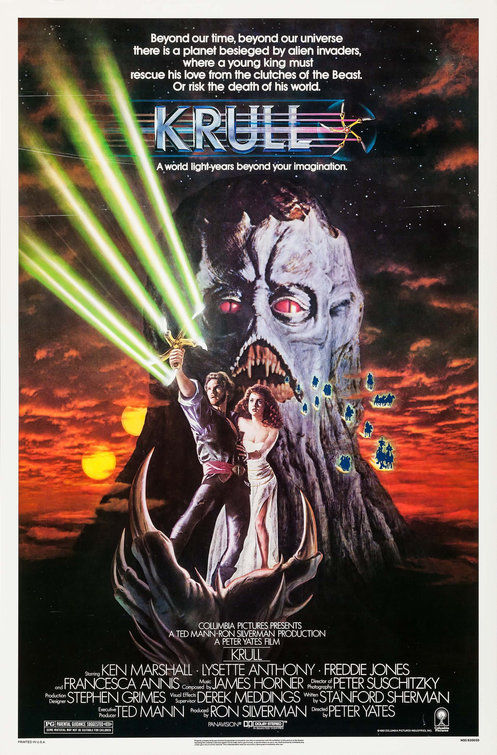
In our pursuit of happiness, or our never-ending flight from disappointment, we are always striving to stay one step ahead of the Hurry Up Monster that chases us from one hurdle to the next. Perhaps he is our career, our fitness, our boss or our biological clock. Perhaps he is a pixellated pterodactyl on a static screen. Or perhaps, like Dumbo's feather, or that swordy-frisbee thing in Krull, the Hurry Up Monster was inside us all along. But just like Dumbo, Luke Skywalker, that dude with the beard in Krull, or the little knight-guy in Joust, we could turn our little ostriches around and go home if we chose to. If we really wanted to. But secretly, for all that we hate the monster and the grind of nearly identical levels that we must face, we all want to play the game and see what comes next. 

Hurry Up!
Image: Impawards.com


P.S.- And for a couple of really odd endings to games, check out these perplexing doozies:

Monster Party (NES, 1989)
Via: k-thor-jensen / Credit: Bandai


MDK (Commodore Amiga, 1997)
Via: Degan Veran/Cracked.com / Credit: Shiny Entertainment


Friday, 13 July 2012

Ghost(s) in the Machine(s)


I think I've lost count of the number of times I've told people I'm just waiting for the day that I can download my mind into a giant robot & run around wrecking stuff up (or more lately, that we could upload ourselves into a world where we can all be giant robots, or anything else for that matter), but this has always been a "one day" dream; something I might live to see, with luck. Now, however, we may find ourselves on the brink of seeing a whole new form of intelligent life emerge under our noses (and above our heads), combining many aspects of these ideas within a handful of years. The thing is, are we ready for it yet?

Even with a direct brain hookup, it's still Pong for one.
- Image: Danshope.com / Wired.com

Last week I read about yet another experiment in which somebody controlled a piece of technology using their mind. Impressive? Yes. New? Not really. Hell, a monkey could do it. No, what was new (for me) was the use of the term "embodying", as the person controlling the robot was able, through cameras & microphones, to see and hear "as the robot". Using this equipment, volunteers were able to use the robot as a proxy, or surrogate, to move about and do things in a room on the other side of the world. With all senses coming from the surrogate, some even reported quickly feeling that it was them doing the moving and doing (When suddenly confronted with a mirror, one reported "Oh look, I have blue eyes!"). This again is nothing particularly new; "telepresence" has been experimenting (albeit badly) with people using robot avatars (in meetings etc.) for decades.

This is what the boardroom at Dalek HQ looks like.
- Images: New York Times


The catch in this experiment however is that, in order to gain the needed precision, volunteers had to be strapped into an MRI machine for the duration, so that the tiny electrical activations within their brains could be monitored in real-time, and in detail. With its noise, close confinement & expense, such a system is something that would seem only to hold any attraction or use for day-players and tourists. Even with a computer body somewhere else to call your own, the sense of confinement would soon have people racing back to their real body and the real world.

But that's only if they have a real world to return to.

Around the world millions of people are paralysed, permanently bedridden or even "locked in", with little or no possible communication with the outside world; they have no "real world" to speak of. Many face the stark reality of living simply as the alternative to being dead, and some would rather choose the latter, when the former may sometimes only differ from it in brain-state and pulse rate. In recent years technology has offered the "locked-in" a chance to communicate with the outside world through sensors that read brain activity or tiny physical movements and allow a computer program to generate text or speech. Indeed, such a system has been on public display for many years through the "voice" of Stephen Hawking (who has, incidentally, repeatedly refused to upgrade his voice to a more realistic tone; having come to accept his distinctive tinny vocalisations as a part of who he is).

What if "surrogate" technologies such as the experiment mentioned above could allow the "locked in" a third choice, beyond death or survival? What if they could get outside, get a job and rejoin the wider world... as a robot?


"Bite my shiny telepresent ass."
- Image: Matt Groening / Fox

Of course at first the idea seems absurd. The person in question wouldn't be a robot any more than a person playing a computer game or driving a remote controlled toy "is" their character or vehicle; the thing is, by many definitions they're not currently living the life of a person either. For a healthy person the idea of spending whole days, let alone every waking hour, lying on a slab, hooked up to machines, is something most would not want to consider. But for those already so confined, this might represent a previously impossible escape into a wider world.

Who says your new body has to have legs?
- Image: Coolrobots.net


For the last few decades (arguably back as far as WW2 research teams have been working on remote-controlled robots (generally known as Waldo units) to undertake specialised jobs too dangerous or even not physically possible for a human body to perform. These range from firefighting, medical applications, logistics, search & rescue, working in radioactive environments and mapping, to exploration and even warfare. To date these have always been operated by guys with joysticks (or occasionally a neural hook-up): "day players", who log off and go home at the end of their shift. So what of the potential for "residential" robot jockeys?

What if your "mini-me" became your actual you?
- Image: Coolrobots.net

Trapped in their own minds at present, here are people often desperate to interact with the world but with little hope of ever doing so. Given access to a remote body, and with no body of their own, as far as physical action is concerned, they could take up permanent residence. All at once they would not so much be locked into their body, as voluntarily locked out of it. An instant WALDO generation.

With little technological progress from where we are today, we could find ourselves sharing our streets with human minds in robot bodies, long before the innovations or surgical techniques required to do so physically are even on the horizon. In 1987 Robocop (and later its dubious sequels) asked about the psychological and societal effects of trying to make a man into a robot. Now I'm left with an interesting thought: what if ED 209 was a person? What if the giant (or small) robots roaming our streets were the eyes, ears, hands and feet (and antennae) of real people, far away? If ED 209 was just Ed, with a wife, two kids and a mortgage; and your roomba used to play jazz guitar?


"I'm looking for volunteers for the company 5-a-side football team. You have 20 seconds to comply... Nah, I'm just pulling your leg... Which isn't easy with guns for hands! I don't know, sometimes I crack myself up... Did you see your faces? Priceless."
- Image: Orion Pictures


Legally, the way is already clear, even if it might require a little polishing. Crimes committed by a surrogate (under direct control, of course) would be attributed to the "pilot"; if possibly via conditions concerning vehicles, objects or weapons. Crimes committed against surrogates would currently only constitute property damage as, psychological trauma aside, the "pilot" would not be physically hurt (developments in haptic technology notwithstanding). But how would the world react to the first crimes committed by embodied surrogates? When the first killing spree is carried out not by a madman with a gun but by the mind within a warplane or a tank?


This one, at least, is friendly.
- Image: La Machine


The main issues I can foresee are societal. How quickly would/could we adjust to the idea that the robots around us aren't just smart but are actually people - ghosts in a machine? Could we get used to people changing bodies the way we currently change jobs? Would this effect be beneficial for the development and adoption of Artificial Intelligence, or shove it back into a small niche for those developing uses for which full autonomy is required, or wireless link-ups are not practical?

Far from being a a nebulous "what-if" for sci-authors to speculate on, our robotic future may be waiting patiently in the (hospital) wings. You may not be able to download your mind into a giant robot just yet...


Image: Spectrum.ieee.org

But you'll be able to stream it.

Sunday, 1 July 2012

SLR - Simple Language Recognition


For all my love of technology I have come to the realisation that I  spend an awful lot of time swearing at it, in its many shapes & forms. But what recently surprised me is quite how much of that swearing is done at my camera.

Yeah, that's right, focus on the gravel. I'm sure it contains some rare  and fascinating aggregate.

I love my digital camera. For too long, since some grit destroyed my last-camera-but-one and a combination of a go-kart-related injury and me losing it in a bar did for the last one (OK, so on balance losing it turned out to be more fatal than my mate running it over), I had no camera other than the one hiding behind the screen-lock and loading time of my phone; so to regain the familiar presence of a point-and-shoot snapper at my hip was a feeling of freedom and reassurance that the world was once again mine to capture (in a presently non-giant-robot-related sense). Although there's no beating a huge, expensive SLR for quality of shots or the simple beauty of the composure, I don't want to have to do the agonising maths entailed in deciding whether to bring something like that along with me whenever I step out of the front door. Am I likely to want it? Can I carry it around all day? Will it be safe? Will I lose it? Will (as happened to a devastated friend of mine) I put it down a little too close to a candle and melt my £300 telephoto lens? Nope, I wanted something I could just tuck into my jeans pocket every day and go from opportunity to shot in less than 10 seconds. And that's exactly what I got. So why does it frustrate me so much?

Because it's bloody stupid, that's why.

I bet she's taking a good picture. Damn her eyes.

Don't get me wrong here. This camera represents the most I've ever spent on a piece of photographic equipment and it has the bells and whistles to show it. It's shock-proof, dust-proof, waterproof (to 5 metres), has a telescopic internal optical zoom (that means no projecting lens to get grit stuck in it), a touch-screen and a switch-on-to-shot time that means I rarely miss a thing. Yet when, in the run-up to buying it, I noticed a photographer friend of mine scowling at his (he'd bought the same model for much the same reason as me, although to supplement his existing SLR) and asked him if he'd recommend it, I was baffled by his reply: "This camera has almost everything I wanted. And I wouldn't wish it on my worst enemy." Well of course I ignored him, didn't I?

I'm a sucker for a special feature.

You see, apart from an "intelligent" (woeful) "touch-to-focus" system, my camera (as with many more recent models) boasts a "superior auto" facility, in which on-board software cunningly identifies what it thinks I'm trying to take a photo of and automatically adjusts its settings accordingly. In fractions of a second it will adjust the settings to take into account light levels, colour saturation and even more complex things such as the presence of faces, horizons or moving objects at different depths of field (although it has such an adorably loose definition of what constitutes a face that it brings to mind the various infant face-recognition experiments of the 1970s & 80s - and has taught me a new word: pareidolia).  The problem is, it's just good enough to be infuriating. Sure, it's fantastic if you want to focus on your friends for a quick snap, or catch an opportunity-shot of some vandals running away from smashing up some bus the other day (see picture), but if you want to try something more ambitious you're back into the realms of chance. Because, for all its "intelligence" (or even "superior"ity), it's all just software looking at what's in front of it and taking a punt at what it thinks you might want.

That's the last time you'll smash up a 57 on a Friday afternoon.

Right now, well into the second century of photography, the best way to take a photo is still to spend half your life savings on a box of mirrors and glass, go on a photography course and learn how to tweak your apertures and focal lengths yourself by turning physical dials. Sure, for art exhibitions and weddings I completely understand this, but what you should be appreciating is the photographer's eye for composition, lighting and focus, rather than their ability to phycially tweak their dials in the right way at the right time. The thing is, SLRs are no longer the only cameras capable of taking such shots, when nowadays even mobile phones are packing high-resolution cameras; the problem is getting out of the realms of chance and into getting the shot you want rather than what you end up with after you press the button and your camera guesses what you meant.

We'll never know what this was meant to be.

Modern digital cameras have tried to overcome the technical difficulties of photography by introducing a baffling array of "scene selections" that pre-configure settings such as lighting, colour-saturation, shot speed and aperture, or even by including a manual focus option, but often the action of finding and configuring these takes long enough that the moment is lost, even if you can find the appropriate one and aren't forced to work it out through trial and error. I found, with an old camera, that I could take excellent "motion-streak" photos by setting it to "night mode" with a slow flash and a long exposure. My new camera, of course, has a much better "night mode", which uses advanced software to carefully remove this effect, thus improving actual night shots and ruining my burgeoning artistic endeavour. What if I wanted it blurry, dammit? 

No, no, no. Look, the light's got all smeared...
There, that's better. This is a Night Shot. Party time.

You shouldn't need to schlep around a digital SLR the size (and value) of a small child in order to take the snaps that your compact has the ability, just not the inclination, to take. The problem is not that digital compact cameras don't have the settings or features required to take the photographs that we want, it's just that they're too buried in software to be accessible (or, if accessible, user-friendly). 

Aha! When I focus on the leaf, lock the focus, then very carefully move the camera over whilst maintaining the same relative distance I can... This is ridiculous.

But that's only a hop and a step away from where the technology needs to be.

Last year the iWorld (and nearly the rest of the world) went iMad for Siri, the sinister in-phone butler that does pretty well at turning "natural language" commands into instructions that it can follow (with some exceptions). So "What's the weather like?" brings up a weather map and "What am I doing on Tuesday, my life is hollow?" returns a non-judgmental look at your agenda. Rather less fanfare greeted Google Goggles, which does its best at recognising objects that the phone camera is pointing at and trying to identify and find links to them.  If somebody were to put the two of these things together we're not a million miles away from a "virtual photographer" that can take simple requests about what to photograph and how to do so. How many times have we cursed aloud at our digital cameras over their choice of lighting or focus, when we could be using pretty much the same strings of words (barring the odd profanity) as instructions just as we line up our shot?

"I want to take the picture just as the foot touches the [blue] ball."
"I want to take the picture just as the first person crosses the [white] line."
"I want a picture of the [red] bug with the background defocused [not the side of that bloody leaf again]."
"I want a picture of their faces as they cross the line [not a blur in front of a perfectly-focused tree in the middle-distance]."
"No, I wanted the Sun reflecting on that puddle, not the random arrangement of sticks at the side that looks like an emoticon smiley. Even though that is quite cool."
"Just for once I want a picture of the moon."

OK, so perhaps in the short term we might not be able to engage in such artistic discourse with our little photographic friend, but the software is certainly there to interpret simple instructions regarding colour and even shape, as well as key words such as "horizon" and "person", which would certainly help in several of the situations above. Of course I would fully expect to find myself swearing at my poor, hapless camera as it found itself misinterpreting my words for the n-th time, but at least it would be able to triangulate what I'm saying with what it's seeing, rather than just taking a punt based on the latter.


No, you're right. The distorted reflection of that overhanging hedge does hold more artistic interest than this spider walking on the frikkin' water.

Can you see this baby frog poking its head out of the water to take its first breath of air? No, me neither. But the limescale on the side of the tank came out beautifully.

Yes I do appreciate the almost fractal-like branching of the leaf lobes, but I wouldn't have minded a better look at the  robin chewing on that live wasp.

Ooh, look! You can actually see the bubbles in the plastic of that bench!

Typical. There you are, carefully lining up your shot of some leaves when a bunch of deer wander in and ruin it. Joke's on them though - still got my leaf shot.

Neither rain nor snow nor performing slug will stay this camera from  the swift completion  of its appointed duty to accurately document the wood-grains on this floor.

And who knows, maybe someday not too far down the line we'll be able to wirelessly think our photographic criteria to our digital photographic assistants, or DPAs (to mint a term), rather than leaving all the mind-machine interfacing to fighter pilots and the terminally locked-in. And eventually, once we've finally got the things hooked directly into our optic nerves, we'll have nobody to blame for our botched shots but ourselves, our short attention spans and the fact that all our eyes ever really see is the inside of a bio-storage pod

"This time I'm going to get that jumping shot just as their feet leave the ground."
Via  http://hookup-articles.blogspot.co.uk/2010/04/mind-reading-machine.html

Right, I'm going out to the garden to take a photo of that spider web that some inconsiderate arachnid has built right next to a feature that looks like Chris Packham. Wish me luck.

Wherever there is an animal doing a thing, there you will find him.

Dammit.

Sunday, 25 March 2012

Jeeves 2.0 - Your Personal Cloud Awaits

OK, I'm going to go right ahead and say it: Owls are a pretty-much hopeless base on which to build a communications infrastructure. In J.K. Rowling's ludicrously popular Harry Potter books these secretly intelligent and loyal predators are an ever-present mail system that underpins much of the magical world, but let's face it, they're rubbish, aren't they? They spend half their time getting lost, killed or just being grumpy about whether or not they've been kept in fresh mice (which one hopes aren't secretly magical or sentient too) and by the time the world (seemingly represented by England) is in crisis everyone resorts to jury-rigging their magical projections into mouthpieces anyway.

There is really nothing stopping wizards from using a phone.

So why even bother to have them in the books? Because they're mysterious, they're cute and, whether we've actually seen one of the razor-brained killers for ourselves or not, they're something personal that follows the protagonists through life and causes them great personal pain when they're lost or stop functioning.

Sounds like an iPhone to me.

Of course, by future/magical standards, phones are currently at least as rubbish as owls; not least because we are at least as much at their beck and call as they are at ours. They may not be hungry for fresh-dead rodents, but who hasn't had their smartphone whinge at them about being hungry until it finally decides to turn its metaphorical back on us and refuse to communicate with us until we feed it?
There is really nothing stopping you from hiring a PA.

A few months ago, with great fanfare, Apple announced the launch of Siri to accompany the new iPhone 4S.  As a voice-activated personal assistant it was pretty likely to change everybody's lives by being able to tell people what the weather was likely to be like soon or get confused about who you wanted to call and, indeed, has proved to be about as useful to enthusiastic adopters as Android 4.0's face-unlock and the Xbox Kinect's Minority-Report-esque hand-swiping interface. It's a nice party-trick to show your friends but at the end of the day you'll just push the buttons and get it done in half the time and far more reliably.

But I've now got so far off the point that I've nearly got lost. Here's the point:

What we need is our own personal robots.


Wait.


I'm going to take a deep breath and say something I never thought I'd let myself think:

Maybe we don't all need our own personal robots.

Let's face it: the little ones are annoying & the big ones want to kill you.
Image: Blade Runner. Copyright: Warner Bros.

With all the advances in robots that can walk, fly, run, jump, unscrew lids from things and maintain pleasant conversation, there isn't really much short-term prospect that they'll be able to do all of this, unobtrusively follow us all of us around (all of us) and quietly run our lives without constantly just getting in our/each other's/their own way or running out of juice and falling over. And what exactly are they going to be getting done as they walk/crawl/fly/slither along? Opening doors for us as they remember our friends birthdays? I've already outsourced my memory to my phone and the doors already open themselves. On the human planetary colony of Solaria envisaged in Isaac Asimov's The Naked Sun, the tiny human population all have dozens of personal robots to assist them with every facet of their lives but I get the feeling that even one would would start to become a hindrance as much as a benefit, until they're good enough to replace us anyway.

I think what we really need (at least to tide us over until we all retreat inside a superpowered personal future, at least) is a personalised infrastructure. My music and photos and videos don't live at home, or even on my phone or MP3 player any more, they're somewhere out "in the Cloud" and can simply be summoned to wherever I need them, whenever I want. Last weekend (Sunday evening to be precise) I thought of a film that my brother had recommended, looked it up on my IMDB app, ordered it using my Amazon app and it was on my desk at work before lunchtime the next day. But we don't even need to rely on people to recommend things for us or even deliver them any more. My new Virgin Media TiVo box arrived last week and after a few days of training it's already pretty good at predicting and automatically recording shows it thinks I'll like (and even has the decency to tell me why). I sold my car last year because I couldn't justify the running costs or afford the insurance any more, but increasing numbers of my friends are turning to ZipCar or similar car clubs, which let them track down a compatible car using GPS on their phone, hop in, drive it wherever they need to, then drop it off somewhere else later. Who needs a car any more when you can have them stashed all over the place just waiting for you?

Of course these systems still leave a lot to be desired. Who hasn't waited days for a parcel that hasn't arrived or had to spend their Saturday morning queuing at the Post Office for something that that couldn't quite be smashed in through the letter box? Who hasn't waited weeks for the one movie they actually wanted from LoveFilm whilst patiently sitting through the dross they don't even remember ordering? And I'm wearily informed by my ZipCar-using friends that picking up (or dropping off) a car isn't quite as easy as radioing KITT and asking him to meet you around the corner in 30 seconds.

Bloody Entropy.

But it's pretty good though, isn't it? Of course we may never (need to) get to the 1950s vision of a vacuum-tube based future, much parodied by Futurama et al,  in which goods and even people are whizzed effortlessly around the metropolis through an innumerable series of interconnected tunnels that connect pretty much everything to pretty much everything else. Sadly after a brief high-water mark the tubes have been relegated to shunting small change around supermarkets. For now our only communication tubes are digital and the physical goods still tend to require some dude in a van to deliver them. For now*.

Imagine the tailbacks around IKEA.

So perhaps a future of personal robotic servants isn't one we need to be aiming towards. Perhaps we'll be happier and more efficient with a PA in our pocket (or wired directly into our brains) and an infrastructure intelligent and integrated enough to get on with organising the rest for us without a power-hungry butler occupying the seat next to us (I can't get a seat on the bus half the time anyway). When I was at university (way back in the mists of time) I was briefly fascinated when the campus got a live webcam streaming a view of the piazza outside the Student Union so that you could see what was going on before you bothered leaving your room to join in (or just get hammered back in halls).  Last November I went laser-shooting at Bunker 51, somewhere under the derelict factories of East London and found myself staring at the prototype of a remotely operated, webcam-targeted paintball turret that armchair warriors can use to punish real people in real woods from the safety of home using a Playstation 3 app. And who wants the robots calling those kinds of shots?
Still can't make my tea though.